

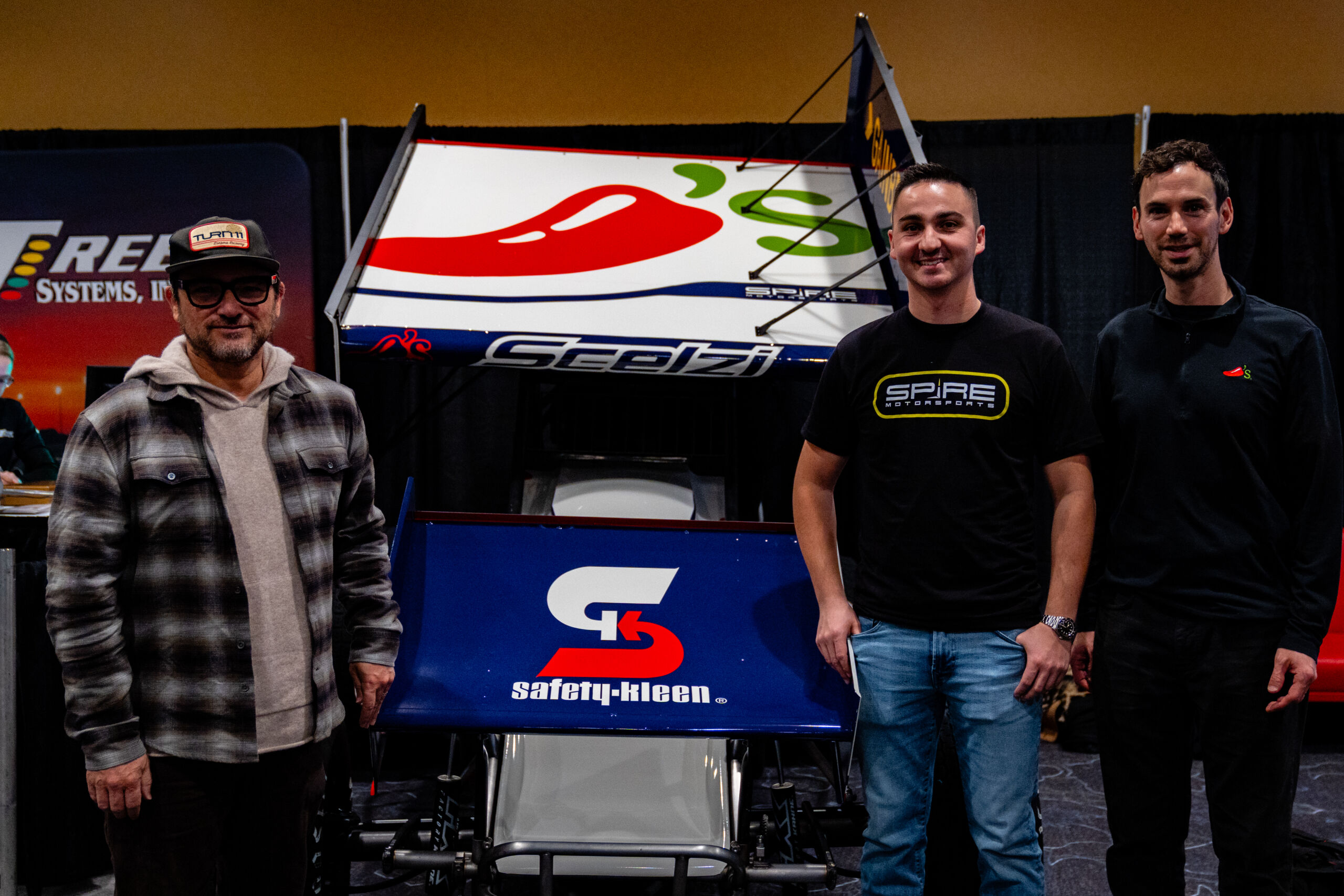
INDIANAPOLIS, Ind.: This year’s Performance Racing Industry Show kicked off like last year’s, and the one before that, and the one before that … with some impactful news that has layers.
In an announcement that was expected for some time, Spire Motorsports announced that they are getting into the ownership game and will field a team with driver Gio Scelzi and crew chief Eric Prutzman. They will compete with High Limit Racing next season in a charter that was purchased from Jason Meyers Racing for just north of a confirmed $400,000.
SprintCarUnlimited.com caught up with Spire Motorsports co-owner Jeff Dickerson just after the release. He discussed his company’s involvement in the sport, what it means for him personally to be involved in dirt-track racing, and much more in this question-and-answer session.
SCU: You are on the front wing of the Clauson-Marshall Raving 7BC and have been involved in Sprint Car racing other ways. What made you take the next step and up your involvement by owning a team?
JD: We’re running our own program in an alliance with the Clauson-Marshall guys. It’s just funny how the sequence of events and the dominos fall. This is something we’ve all talked about doing, but it happened in a weird way. When Sunshine [Tyler Courtney] got hurt, obviously, that brought Gio into the family. You get to Knoxville, and you hear that you might get Eric Prutzman, and he might want to come back to national racing. Then, we are at Knoxville, and Jason Meyers wanted to come off a national tour. Truly, these were not hard decisions. They were essentially made for us in a way. We then brought it up with Chili’s. We had a long-lasting relationship with them on the NASCAR side, so this wasn’t landing on the moon. This was a lot of things that were just like most of my life … right place, right time, and that’s how we got here.
SCU: Spire has the NASCAR Cup side, and some people in the dirt world associate you with that. There is that divide with some dirt fans and asphalt, so what would you tell the worried dirt fan who might get mad that it’s more NASCAR involvement in Sprint Car racing and not like it?
JD: I appreciate you asking that. We’re not interlopers. We’re not a NASCAR team that is coming to run Sprint Cars, right? We are dirt racers that happen to race NASCAR. This is — speaking of myself — is what I come from. My first time going to a dirt-track race was with my neighbor at Lincoln Park Speedway in 1988, and I don’t think I’ve missed a race somewhere since that weekend. So, clearly, I’m like these guys that are walking around this show or knocking dirt off the car and working on these cars. I’m closer to you, the dirt racer and fan, than I am to some big-time NASCAR owner. I think the other part we are trying to show is that it’s cool that everybody gets to see Kyle [Larson] come back, and there’s always been guys that come back and race … so, we’re all only one removed from each other. With a group like ours and my partners owning the Formula 1 team and then the Sprint Car team, everybody is a degree from each other. With motorsports, we all have a hand in making this a success. You see NAPA is already in the sport. Now, we have Chili’s in the sport. I hope that everybody sees that we have a shared responsibility to show big companies that when they come here, our fan base is powerful, and our fan base loves motorsports, and our fan base supports sponsors that are in motorsports. That’s how the next big brand comes in, and they won’t be coming to Spire, they’re going to go to the next team and the team after that. It doesn’t mean that we’re selling out. It’s showing that it validates what everybody is doing in Sprint Car racing. I think the other part here is that High Limit and all these national series are the majors. They are NASCAR. That doesn’t mean you sell out your roots … it means, ‘Hey, it’s the majors, and companies want to come play. Two things can be true. You can still be. True to your roots and yourself and also have national sponsors that come in and want to support your series. That’s how we all grow.
SCU: What made you purchase a charter/franchise for High Limit instead of just coming out and running the next two years trying to earn one?
JD: I don’t know that we would have made the leap to run a full national series at this stage of the game if we didn’t have that opportunity with Jason [Meyers]. We had a good agency for years and years, and we didn’t get into the ownership side of it until NASCAR came up with their charter system. You recognize getting in on the ground floor of something is a big deal, and you want it to make business sense. Certainly, what we’ve seen on the NASCAR side is that for team owners, this kind of system makes it where when you are selling at the end of your journey, you have something tangible to sell. For us, I don’t have car dealerships. I now have some outside businesses, but you don’t start there. So, this is how we eat. We’re not team owners that can be like, ‘The hell with it, whatever happens, it’s good with us.’ It doesn’t matter if it’s the Cup team or the Sprint Car team or anything else … we take it really serious. That’s why it’s important to have Chili’s involved, and it’s why it’s important to have the partners that we have around us … it’s because this is legit how we eat. So, that’s where that system that High Limit put in place at the end of the road — and I hope we are here 50 years, at least — you have something that you’re selling to the next guy that has some kind of enterprise value. Look, a lot of people thought we were crazy when we bought our first charter for $6 million. Time proved that we were right.
SCU: I’ve heard from some industry contacts that I have that you paid over $400,000 for the charter. What made you do that and go with High Limit?
JD: I can’t get into specifics, but we were north of $400,000. We see the value in High Limit. It’s also about working with Brad, and it all just lined up. I remember a couple of years when Brad called, this wasn’t even on our radar. When he called with the idea of it, and he talked about the pillars of what he wanted to do … he did it. He wanted transparency, he wanted something solid for team ownership and racetracks, and he wanted everybody to feel like they were part of it. He did that. So, take away the friendships and everything, it’s just what they’ve done on the business side of it. That resonates with us. I think what Brad and Kyle are doing here, everybody needs to take notice … this is real. When you have their background, add in Flo, and then the teams that they have, sometimes the decisions get made for you. They’ve got a great schedule, and this is just the tip of the iceberg. This wasn’t hard. You have to look down the road 10-20 years, and when you are talking about those kinds of numbers, the only direct comparison that we have is the NASCAR side. When we paid $6 million for it, everybody was like, ‘You guys are the dumbest guys we’ve ever seen.’ Now, you read that these things are trading for $50-55 million for the worst ones. I think High Limit, in a way, is trying to do the same thing. These are real businesses going up and down the road. There is nobody po-dunking their way up and down the road. This is the big leagues, so I think with the model that High Limit has, it makes it where that’s not a pipe dream. It’s real, and if we are all pulling in the same direction and have a seat at the table, you feel like you have a say in High Limit. That’s a big deal.
SCU: You have a Sprint Car now, and you have two guys in Gio Scelzi and Eric Prutzman who have won races. What are your expectations and do you see more involvement in Sprint Car racing for Spire?
JD: This is not a traditional start up. We are not showing up at the racetrack trying to figure out how to get the car out of the trailer. We are showing up in an alliance with CMR with Eric Prutzman as the crew chief and Gio as a driver. With all due respect to our competitors, I feel like we’re going in with the expectation that we’re trying to compete for a championship from Day 1. I don’t know that there is a teething process for what we’ve got cooking here. It might take a moment. I don’t think Gio and Eric have worked very much together, but that might be the only thing that holds us back at the start, just them trying to figure each other out. I wouldn’t be shocked if we won in Las Vegas. Eric knows how to build a team and exactly how these things go and how to compete at the national level. Gio, even as young as he is, has experience out on the road. So, with our other race teams, we’ve had to walk before we run. I feel like this is the exact opposite. We’re coming to win and to compete for a championship from the first green flag. As for your other question, I don’t know what else we can do. We were at Gateway last week with the Late Model and Carson [Hocevar] and putting that together, it’s just the guys in the shop … it’s something to do and then this. As far as the economics of it. Do we run a truck program, or do we run a Sprint Car program? We had four trucks last year, and we’re taking that down to two and a half this year, but we took those third and fourth programs, and we turned it into a Dirt Late Model and Sprint Car deal. So, perhaps we don’t get more involved, but again, if it shows other like-minded teams like Trackhouse or someone like that, ‘Hey, the water is good over here, just come in,’ that’s maybe more of what we want to do.
SCU: With bringing Chili’s in and developing a Sprint Car team, do you think this shows others the value of Sprint Car racing?
JD: Big companies aren’t throwing money at things because they are cool. They are investing in products that will pay off for them. So, that’s why I’m kind of talking about shared responsibility. If they see the viewership numbers spike at Flo, then there’s proof of concept. If they see where we’re going down the road, there is a bump in sales, it’s proof of concept. All of these companies talk to each other, and that’s why companies are monkey see, monkey do. They’re not following each other blind. They see if it’s successful, then they all hop in. That’s going behind the curtain a little bit, but that’s part of the sport. We all have a hand in making this a success. I don’t think Chili’s does this if NAPA wasn’t already there. If another sponsor comes in, they’re going to end up on the national tour with somebody. If you have 15 teams with all recognizable direct to consumer brands, that’s a pretty good series.